














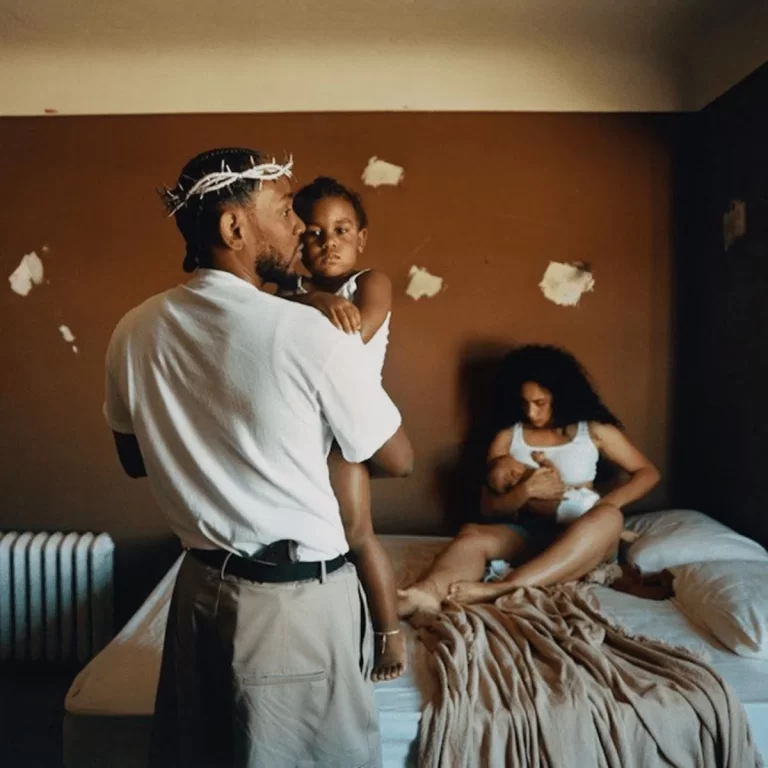


Album: “Mr. Morale & The Big Steppers”
Artist: Kendrick Lamar
Genres: Conscious Hip Hop / West Coast Hip Hop
Year: 2022
Por: Ricardo Arriagada Gómez
Translation By: Emily Maria Diaz
The changes which have manifested in just the past five years have been monumental in domestic and global contexts. Within that, before the pandemic, we had a Kendrick Lamar who revealed his vulnerability through «DAMN.» (2017), an album which once again throned him as the -potentially- most influential artist of the last decade. As the clock ticked, audiences knew very little about Lamar’s next release until it was announced that his final production with Top Dawg Entertainment would initiate his return: this new album would both more deeply reflect the cleansing of his inner demons and how his personal life affected him being a father, husband and a black man in America in which the fight against racism and the prison industrial complex took a toll on his mental health.
Regarding the album’s conception and considering how much Lamar likes to create narrative-driven works of music, «Mr. Morale & The Big Steppers» is a theatrical production in which the stage presents the inner workings of his mind. We sit through an elongated therapy session through this album, in which Lamar unveils his dark side and attempts to reveal how the traits he recognizes in himself have been affected by all that he has undergone in life. From past to present, he discusses traumas from his adolescence, empty excess of fame which do not fill the void, issues of religious beliefs, COVID, cancel culture, and his partner (who actively participates on several tracks), Whitney Afford’s infidelity which he forgave. His West Coast Hip Hop music arsenal and his vocal expression are thoughtfully intertwined, accompanied by some interesting collaborations and Hip Hop subgenres that intervene depending on the level of musical narration. It’s captivating how rather than using beats as on his previous album or the ambition of his magnum opus «To Pimp a Butterfly» (2015), the piano plays a fundamental role in the lyrics for this album.
In its first half, Kendrick Lamar expresses his private life in the midst of the pandemic with the resounding «N95» which exhibits more of a Trap beat, more Abstract tracks such as «Worldwide Steppers» and the raw «Father Time» recount his confrontation with his ego and misogyny, which affect his character as a father, his insecurities and closeness to God in the pop songs, «Die Hard» and in «Purple Hearts» involve powerful beats which play a significant role. In addition, including Sampha, Blxst, Amanda Reifer, Summer Walker, and Ghostface Killah on the aforementioned tracks make for superb company. In its second half, decadence is healing as Lamar accepts his mistakes and must open up to feel relief. He questions his terrifying destiny and that of his friends in the world of Rap in «Silent Hill» and demonstrates his own salvation in the tremendous «Savior» and «Mirror», which end but not without first going through the heartbreaking «Mother I Sober» which highlights the presence of Beth Gibbons and confesses that her humility fell into the hands of selfishness, seeking healing help against traumas so as not to affect her environment. The usage of synthesizers, softer rhythms, and the leading piano assert themselves, especially in this part. How both tracks relate to one another is important for getting into their themes, as is being omnipresent in order to feel the shocking daggers that, thanks to his silence and disappearance before the cameras, a new Kendrick Lamar had been cooking up.
A production that incorporates powerful moments such as the uncomfortable «We Cry Together» or the reflection of xenophobia and homophobia in «Auntie Diaries», reflects this album’s duality as it portrays both Lamar’s downfall and gradual repair. We are in the presence of the king’s therapy, and though some tracks were not the best in his repertoire -despite naming many that are totally worth it- it’s one more wonder from one of the most influential artists of recent times. With lyricism more potent than its musicality, this album is no match on several levels compared to «good kid, m.A.A.d city» (2012) or the previously mentioned «To Pimp a Butterfly» (2015) yet, it also lands within a solid discography of music and is a favorite of this year.
Top picks to listen to on the album?:
Die Hard – Father Time – Purple Hearts – Auntie Diaries – Mother I Sober – Mirror

0 Comments